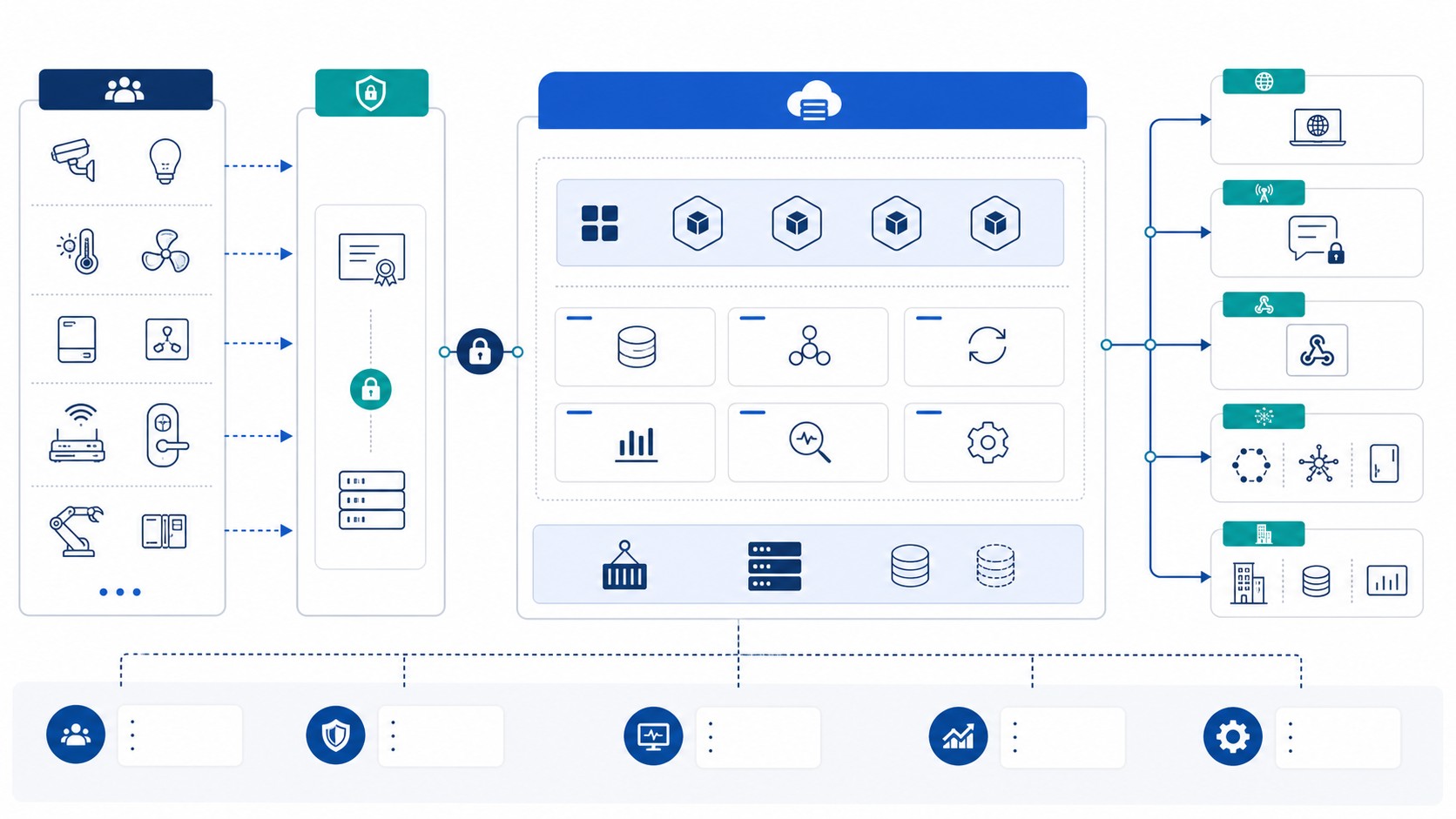
Private Cloud explains the two deployment tiers and Realtek Connect+'s infrastructure model. The platform runs as a standard container or VM workload, giving customers full choice of cloud provider or on-premises infrastructure. This is explicitly different from serverless-native IoT platforms that tie private deployment to a single cloud account.
VM/container deployment on GCP, Azure, AWS, or on-premises — no cloud lock-in
Free evaluation tier with up to 200 devices on request and no expiry
Commercial tier with one-time license plus annual maintenance and no minimum scale
Capabilities
Platform building blocks
Container or VM workload deployment on any major cloud provider or on-premises data center
Reverse-proxy TLS termination, network policy alignment, and branded service endpoints
Release promotion and maintenance-window planning across evaluation and production environments
Outcomes
Why product teams use it
Avoid cloud vendor lock-in for IoT infrastructure
Keep ownership and residency boundaries explicit
Create a credible path from pilot to production on your own terms
Deployment Paths
Compare evaluation and private commercial operating models
Realtek Connect+ positions deployment choice as a commercial decision. The infrastructure model stays the same — containers and VMs — regardless of which tier or cloud the customer chooses.
Model
Infrastructure
Device quota & cost
Best fit
Public evaluation
Shared environment hosted by Realtek.
5 devices by default, up to 200 on request. Free, non-commercial use only.
Early evaluations, internal validation, and short proof-of-concept cycles.
Managed private deployment
Container/VM on customer-selected cloud (GCP, Azure, AWS) or on-premises, operated with agreed support windows.
No device floor. Commercial agreement: one-time license fee plus annual maintenance — contact sales for quote.
Teams that want private deployment outcomes without owning the day-to-day platform operations stack.
Customer-operated private region
Customer-owned container/VM infrastructure — any cloud or data center — with coordinated release and upgrade planning.
No device floor. Commercial license + maintenance plus the customer's own infrastructure costs.
Products with strict enterprise governance, regulated data boundaries, or multi-cloud / on-prem mandates.
Infrastructure Model
Standard container and VM workloads — no serverless dependency
Realtek Connect+ private deployments run as conventional container or VM processes. There is no serverless runtime requirement and no dependency on a specific cloud provider's managed services.
Deploy on GCP, Azure, AWS, or your own on-premises data center using standard container orchestration (Kubernetes, Docker Compose) or VM images.
Unlike serverless-native IoT platforms that require the customer to own a specific cloud account (e.g., AWS Lambda + DynamoDB), Realtek Connect+ has no infrastructure prerequisites beyond a host that can run containers or VMs.
This means regulated industries, enterprises with existing data center contracts, and teams with multi-cloud policies can deploy without restructuring their infrastructure strategy.
Commercial Models
Start with evaluation, then move into owned deployment boundaries
Public evaluation gives fast PoC access on shared infrastructure. Private commercial deployment is a dedicated environment on infrastructure you choose.
Use the public evaluation environment to validate device flows, dashboards, and integration assumptions before committing to a customer-specific operating boundary.
Transition to a dedicated private deployment once product teams need tenant isolation, formal support processes, and customer-specific change windows.
The evaluation tier is suitable for development and pilot work; commercial products with real device fleets require a private commercial agreement.
Plans & Limits
Evaluation tier limits and the path to commercial scale
Concrete limits so developer teams can plan a pilot without surprises, and a clear handoff into the commercial conversation when the pilot grows.
Evaluation accounts start with a 5-device default quota and can be raised up to 200 devices on request.
Evaluation access does not expire — request a quota raise or a commercial conversation when your fleet grows; we do not auto-cancel evaluation accounts.
Evaluation use is limited to development, proof-of-concept, and internal validation; commercial product shipments and customer-facing fleets require a private commercial agreement.
Self-service signup with email verification is on the roadmap; pre-launch evaluation accounts are issued by the Realtek Connect+ team via the contact form.
There is no minimum scale for the commercial tier; small fleets can move out of evaluation as soon as commercial use begins, even before they reach the 200-device evaluation ceiling.
Pricing Factors
How commercial pricing is shaped
We do not publish a price list — every commercial deployment is sized to the customer's actual scope. The factors below are the inputs the sales team uses when preparing a quote, so buyers can frame the conversation before getting on the phone.
Fleet size — total addressable device count for the deployment, including planned expansion within the contract term.
Deployment topology — single-region managed deployment, multi-region, or fully customer-operated infrastructure across one or more clouds or on-premises sites.
Support coverage — the response-time, escalation, and on-call expectations the customer needs in their support agreement.
Customization scope — branding/white-label, custom domain handling, and any product-specific platform extensions beyond the standard release.
Term length — typical contract structure is a one-time platform license fee plus annual maintenance; multi-year terms are quoted separately.
SDK Licensing
What you can build with
SDK distribution today and the planned posture at general availability.
Realtek Connect+ device SDK packages (Native C, Android, iOS, JavaScript/TypeScript, Go) are currently distributed under evaluation terms.
An open-source SDK release is planned at general availability, so commercial customers and the wider community can integrate without bespoke license negotiation.
The platform backend stays a proprietary commercial product; private deployments install signed builds rather than building from source.
Support
What support looks like at each tier
Support coverage is intentionally tiered: evaluation gets a self-serve community lane, commercial gets contracted accountability.
Evaluation support is community-tier: documentation, integration guides, and the public issue tracker for the SDK once it is open. There is no response-time commitment on the evaluation tier.
Commercial support is contract-defined: response-time, uptime, and escalation paths live in the customer agreement rather than a published tier matrix.
Customers needing a specific SLA structure should raise it during the commercial conversation so it can be priced and committed inside the agreement.
Ownership
Define where data lives and how the service is branded
Private deployment gives customers control over data residency, access boundaries, and service identity.
Device metadata, operator access logs, and retained support exports stay inside the customer-owned environment — no data crosses to a shared Realtek-operated region.
Custom domains and branded entry points let the deployment align with the customer's DNS, certificate, and support model.
Choose regional placement around residency, latency, and operational coverage requirements rather than accepting a fixed shared region.
Upgrade Path
Promote proven configurations into commercial production
The upgrade path is an engineering and operations workflow, not a one-click migration promise.
Carry validated device models, app configuration, and integration settings from evaluation into a dedicated deployment plan.
Use release promotion, maintenance windows, and rollback checkpoints to move from pilot tenants into production operations safely.
Align the commercial cutover with customer security review, support readiness, and staged onboarding of real fleets.
Deployment FAQ
Questions enterprise buyers raise first
Direct answers to infrastructure and procurement questions.
What infrastructure does private deployment run on? Standard containers or VMs — bring your own GCP, Azure, AWS, or on-premises host.
Is there a cloud vendor requirement? No. Realtek Connect+ has no dependency on a specific cloud provider's managed services or serverless platform.
Commercial support covers deployment planning, environment hardening expectations, and the path for future platform customization requests.
Next step
Evaluate Private Cloud for your product roadmap.
Share your product category, target deployment, and cloud requirements with the Realtek Connect+ team.